The Geometry of Feeling: Reading the Japanese Close-Up as a Cinematic Language
In the standard Hollywood close-up, the message is legibility. The camera moves toward the face because the face is about to tell us something—grief, realization, desire, resolve. Lighting is calibrated to minimize shadow. The frame is centered. The actor's instrument is on full display. The audience receives the emotion directly, the way one receives a delivered package.
Spend time with Japanese cinema and you begin to notice that close-ups operate on a different set of assumptions. The face may be partially obscured. The light may fall at an angle that throws one eye into darkness. The character may be looking not at the camera but slightly away from it, toward something the frame refuses to show. The emotional content is present, but it must be inferred rather than received. The audience is not handed the package; they are shown the room it came from.
This is not a stylistic accident. It reflects a coherent visual philosophy—one rooted in cultural attitudes toward interiority, social performance, and the ethics of display.
What Hollywood Assumes About Faces
To appreciate the distinction, it helps to articulate what the dominant Western approach takes for granted. Hollywood cinematography, broadly speaking, treats emotional transparency as a virtue. The character who cannot hide their feelings is sympathetic; the character who can is suspicious. Close-ups are deployed at moments of emotional climax to confirm what the narrative has been building toward—the tearful confession, the dawning horror, the quiet triumph.
The technique has deep roots in the theatrical tradition that early American cinema inherited, where projection to the back row was a professional obligation. Even as film developed its own language distinct from theater, the preference for emotional legibility persisted. Contemporary blockbusters have only intensified it: reaction shots are cut faster, held longer on the most expressive frame, scored to remove any ambiguity about how the viewer should respond.
This approach is extraordinarily effective at generating immediate, shared emotional responses across large audiences. It is also, by its nature, a closed system. The meaning is supplied. The viewer's role is to receive it.
The Averted Gaze in Ozu's Compositions
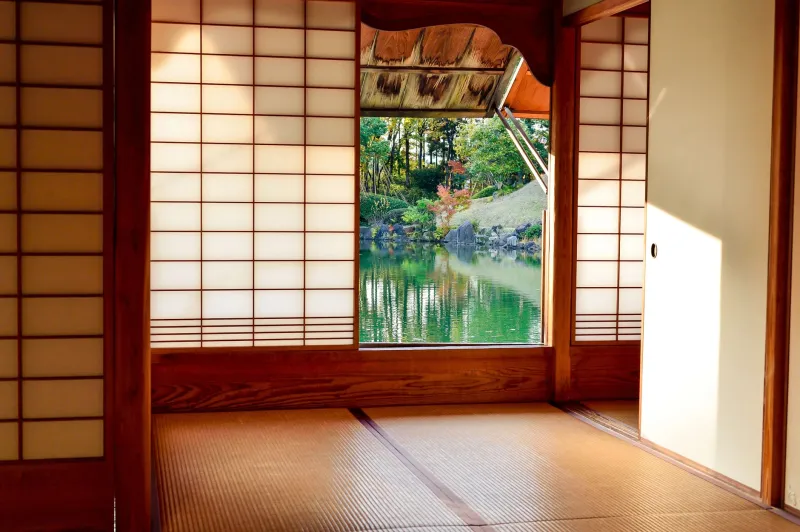
Yasujiro Ozu's camera placement is among the most discussed formal choices in film history, and for good reason. His signature low angle—positioned roughly at the eye level of someone seated on a tatami mat—creates a relationship between viewer and subject that feels simultaneously intimate and formal. But it is his treatment of eyelines that most directly distinguishes his close-ups from Western conventions.
Ozu's characters rarely look directly at one another during conversation. They speak to a point slightly off-camera, so that the viewer occupies an impossible position in the scene's geometry—present but unaddressed, witnessing an exchange without being incorporated into it. In Late Spring (1949), the scene in which a father watches his daughter laugh at a Noh performance is constructed almost entirely through this technique. We see his face in close-up; we see her face in close-up. Neither acknowledges the other's gaze. The emotional content of the scene—the father's awareness that he is about to lose his daughter to marriage, the daughter's unguarded happiness that makes the loss feel more acute—is communicated entirely through juxtaposition and withheld connection.
A Hollywood director staging the same moment would likely have the father and daughter make eye contact, perhaps share a small smile that encodes the bittersweetness. Ozu refuses this. The emotion is more powerful for remaining unconfirmed.
Shame, Framing, and the Ethics of Exposure
Japanese cinema's treatment of shame as a visual subject reveals the cultural stakes underlying these compositional choices. In a social framework that places significant weight on the management of face—the presentation of self within hierarchical relationships—to expose a character's shame in full close-up is not a neutral act. It is, depending on the directorial intention, either a violation or an act of profound empathy.
Masahiro Shinoda's work is instructive here. In Double Suicide (1969), a loose adaptation of a Bunraku puppet play, Shinoda frames his characters' moments of greatest anguish in compositions that deliberately fragment the face—a partial profile, a face cut by a doorframe, a reflection that doubles and distorts. The effect is to suggest that shame cannot be looked at directly, that full frontal exposure would itself be a kind of cruelty. The camera becomes complicit in the social logic it is depicting.
Kore-eda employs a related technique in Nobody Knows (2004), where close-ups of the children's faces are held past the point of comfort—not to extract emotion but to insist on a witnessing that the wider world in the film refuses to perform. The length of the gaze is itself the argument.
Kurosawa's Contrasting Grammar
It would be reductive to suggest that all Japanese directors share a single approach. Akira Kurosawa's close-ups are frequently among the most dramatically direct in world cinema—think of the rain-soaked faces in Seven Samurai (1954), where extreme close-ups are deployed with an almost operatic intensity that owes as much to John Ford as to any Japanese tradition.
But even Kurosawa's most emphatic close-ups tend to be embedded within a compositional logic that differs from Hollywood norms. His widescreen frames frequently position faces at the edges of the image, allowing landscape or architecture to occupy the center, so that the close-up, when it arrives, registers as a deliberate intrusion of the personal into the monumental. The face does not fill the frame; it claims a portion of it, in tension with everything else the shot contains.
This spatial relationship—between figure and environment, between the person and the world pressing in on them—is a recurring structural feature of Japanese cinematography that American viewers often read as stylistic preference when it is, more precisely, a philosophical statement about the relationship between individual psychology and social context.
Learning to Read the Frame
For American viewers, developing literacy in this visual language requires a shift in viewing posture. The instinct to wait for the legible moment—the face that confirms the emotion—must be partially suspended. Attention should be directed toward what the frame excludes as much as what it includes: the direction of the averted gaze, the portion of the face left in shadow, the distance the camera maintains when Hollywood would move closer.
This is not a passive exercise. It is a form of active interpretation that Japanese cinema invites and rewards. When a director like Kore-eda or Naomi Kawase withholds the confirming close-up, they are not failing to deliver emotional content—they are asking the viewer to generate it, to complete the circuit themselves.
The result, for viewers who make this adjustment, is a more genuinely collaborative experience than the Hollywood model typically offers. The emotion is not delivered to you. It is constructed between you and the screen, in the space the frame deliberately leaves open.