Falling Without Rising: How Japanese Cinema Reimagines the Shape of a Story
Every American moviegoer absorbs, almost by osmosis, a certain expectation of how stories move. A protagonist encounters a problem, endures escalating trials, reaches a crisis point, and then—through will, ingenuity, or love—overcomes. Joseph Campbell codified this rhythm as the monomyth, the hero's journey, and Hollywood has treated it less as a scholarly observation than as a production mandate. Even films that claim to subvert the formula tend to deliver their subversion on schedule, with a knowing wink.
Japanese cinema, at its most distinctive, does something more unsettling: it questions whether overcoming is the point at all.
The Concept at the Center
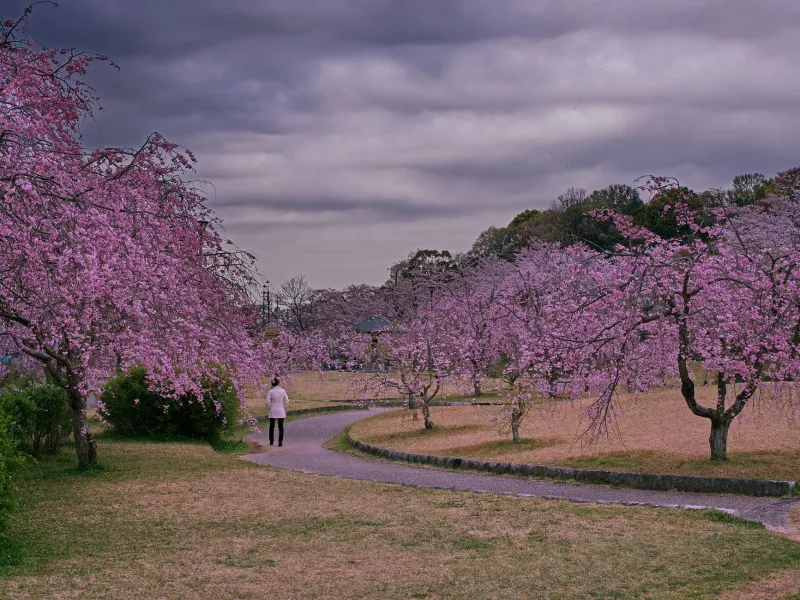
Mono no aware is a phrase that resists clean translation, which is itself instructive. Literally rendered as "the pathos of things," it describes a particular emotional register—a gentle, aching sensitivity to the fact that everything beautiful is also temporary. Cherry blossoms are the canonical example in Japanese culture, admired precisely because they fall. The feeling is not despair; it is closer to a sustained, clear-eyed tenderness toward the world's transience.
When this sensibility becomes a structural principle rather than a decorative mood, it produces narratives that do not arc so much as breathe and then go still. The protagonist does not conquer the antagonist. The relationship does not resolve. The loss is not redeemed. And yet the film does not feel nihilistic, because the emotional truth it honors—that things pass, and that their passing matters—is profound rather than merely bleak.
Ozu and the Deliberately Incomplete Arc
Yasujiro Ozu is the clearest starting point for any discussion of this structural philosophy. In Tokyo Story (1953), a retired couple travels from the countryside to visit their adult children in the city, only to find themselves gently, politely sidelined. The children are busy. Life has moved on without them. There is no villain, no confrontation, no cathartic reconciliation. The film ends with the father sitting alone, watching the sea.
A Hollywood instinct would find the latent drama here irresistible—the estranged family, the dying mother, the ungrateful children—and transform it into a reckoning. Ozu refuses. The emotional weight of Tokyo Story comes not from what is resolved but from what is simply witnessed. American audiences encountering it for the first time frequently report a specific kind of discomfort: the sense that they have been waiting for the film to begin its real story, only to realize, sometime after the credits roll, that they were watching it the entire time.
Grief as Destination, Not Detour
Hirokazu Kore-eda, working decades after Ozu, has extended this tradition into contemporary Japan with remarkable consistency. After Life (1998) constructs its entire premise around the moment of death—the newly deceased must select a single memory to carry into eternity—and yet the film's interest is not in resolution or transcendence. It is in the act of remembering itself, in the way ordinary moments accumulate into something that, looked at from the right angle, constitutes a life.
Kore-eda's Still Walking (2008) is even more rigorous in its refusal of catharsis. A family gathers annually to mourn a son who died years earlier saving a drowning stranger. The surviving son carries a complicated guilt; the parents carry a complicated resentment toward the man their child saved. The film ends without anyone saying the thing they need to say. The wound remains open. And the final images—a graveyard visited years later, the parents now gone—suggest that the wound was always going to remain open, that this is simply the condition of loving people across time.
For viewers trained on grief narratives that culminate in release, this can feel like a withholding. It is, in fact, the opposite: an insistence on taking grief seriously enough not to resolve it artificially.
The Hero Who Does Not Return
Campbell's monomyth requires the hero to return from the ordeal transformed, bearing gifts for the community. Japanese cinema is full of characters who undergo profound transformation and then disappear—into death, into solitude, into an ambiguity that resists the homecoming structure entirely.
Takeshi Kitano's Hana-bi (1997) follows a former detective undone by violence and guilt. The film's climax is not a redemption but an erasure—a final act that forecloses the possibility of return by design. What Kitano constructs in the space of that ending is not tragedy in the Western sense, with its implication of a fate that could have been otherwise. It is something closer to completion: a life that has run its course, acknowledged without flinching.
Mikio Naruse's melodramas, particularly Floating Clouds (1955), present female protagonists who resist and endure and love with extraordinary intensity—and who are ultimately not saved by any of it. Naruse's heroines are not defeated by their circumstances so much as worn smooth by them, like stones in a river. The distinction matters. Defeat implies that a different outcome was possible. Naruse suggests that the current was always going this direction.
Why American Audiences Find This Unforgettable
There is a particular kind of film that American viewers describe, years after watching it, as having "stayed with" them in a way they cannot quite explain. Often, on examination, these are films that declined to provide the emotional discharge the viewer expected. The feeling was not resolved; it was deposited somewhere inside and left to age.
Mono no aware operates precisely through this mechanism. By refusing to convert impermanence into triumph, Japanese cinema creates a different relationship between film and viewer—one in which the audience must sit with incompleteness rather than be released from it. This is not a deficiency of storytelling craft. It is a different theory of what stories are for.
The hero's journey assumes that the point of an ordeal is what it produces: the transformed hero, the restored community, the hard-won wisdom. The mono no aware tradition assumes something quieter and, arguably, more honest—that the point of an experience is the experience itself, including its ending, including its loss.
To watch Japanese cinema seriously is to practice tolerating that distinction. And for audiences willing to make that adjustment, the reward is access to an emotional register that Hollywood, for all its technical sophistication, rarely touches.