The Room as Argument: How Japanese Directors Build Meaning From the Ground Up
There is a moment in Hirokazu Koreeda's Shoplifters that arrives without warning and without words. A family of mismatched individuals sits crowded beneath a low ceiling, their bodies pressed together not out of affection but out of sheer spatial necessity. The room is small. The world outside is enormous and indifferent. That compression—physical, emotional, economic—is not incidental to the story. It is the story. Koreeda did not need a character to announce that these people are clinging to one another because the alternative is oblivion. The room already said it.
This is the grammar of Japanese spatial cinema, and it operates according to rules that reward patient attention.
Architecture as Emotional Infrastructure
American filmmaking has long treated set design as a support system for performance. The room exists so that actors have somewhere convincing to stand while they deliver the lines that carry the film's meaning. In the dominant Hollywood tradition, dialogue is the load-bearing wall. Everything else is decoration.
Japanese directors working in the contemplative mode—Koreeda most visibly, but also Ryusuke Hamaguchi, Naomi Kawase, and the late, irreplaceable Yasujirō Ozu before them—invert this hierarchy. Space is not decoration. It is infrastructure. The physical arrangement of characters within a room, the distance maintained between them, the threshold they do or do not cross: these are not illustrations of an emotional state already established by dialogue. They are the primary evidence from which the viewer is expected to draw conclusions.
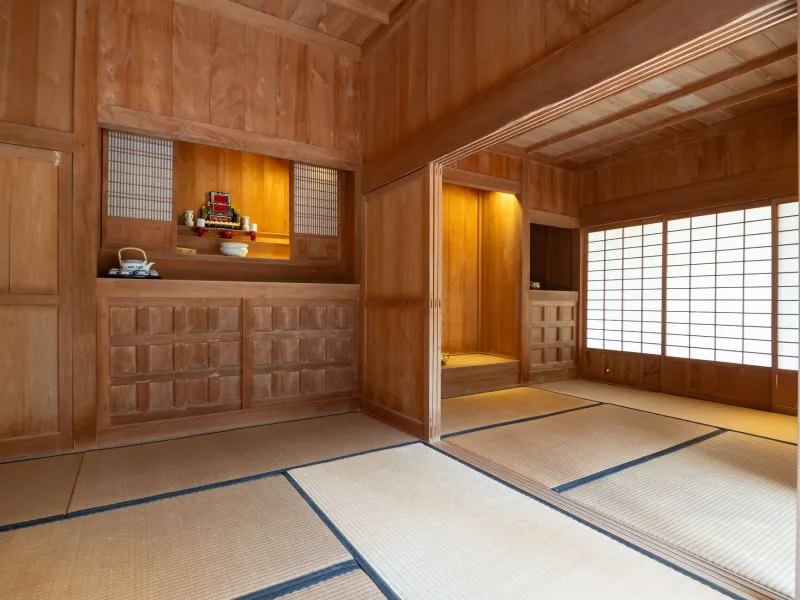
Ozu understood this decades before it became the subject of academic analysis. His signature low-angle, static compositions were not aesthetic quirks. They were a deliberate insistence that the viewer occupy the same spatial plane as the characters, seated on a tatami mat, looking up at a world organized by invisible hierarchies of obligation and restraint. When a son and his aging father sit at opposite ends of a narrow corridor in Tokyo Story, the geometry of that shot is a complete sentence about generational distance. No one needs to say anything.
The Hallway as a Moral Argument
If the room is the unit of emotional architecture in Japanese cinema, the hallway is its most charged punctuation mark. Hallways in American film tend to function as transitional spaces—the place you pass through on your way to somewhere important. In Japanese filmmaking, they are frequently the somewhere important.
Consider how Koreeda uses the narrow corridors of domestic spaces in Still Walking to choreograph the slow, painful orbit of a family around a grief they cannot name. Characters do not confront one another directly. They pass. They pause at doorways. They speak to someone in the next room rather than entering it. The physical reluctance to occupy the same space as another person becomes a precise map of psychological avoidance. An American viewer accustomed to scenes of direct confrontation may initially read this as evasiveness. It is, in fact, a form of devastating honesty.
Hamaguchi, whose Drive My Car introduced many American audiences to a more contemporary iteration of this spatial philosophy, uses the interior of an automobile—itself a kind of moving hallway—to achieve something similar. Characters who cannot look at one another directly are placed in a vehicle where looking forward is the socially expected behavior. The car's architecture enforces an emotional permission structure. The conversation that unfolds in that space could not have happened across a dinner table. The geometry made it possible.
Power, Distance, and the Negotiated Frame
One of the most reliable signals in Japanese spatial cinema is the deliberate calibration of physical distance to communicate power dynamics. Where Hollywood might use a close-up to signal dominance or vulnerability, Japanese directors often prefer to keep the camera at a remove and let the distance between bodies carry that weight.
In Broker, Koreeda places a social worker surveilling a group of characters from across a parking lot, a highway overpass, from behind glass. She is watching, but she is also excluded. The physical separation is not merely tactical—it is a moral condition. Her distance from the warmth occurring within the frame is the film's central ethical question rendered in square footage.
This technique asks something specific of the American viewer: a willingness to read negative space as meaningful rather than empty. The gap between two characters standing in a kitchen is not a staging oversight. It is a measurement of something unresolved. Learning to take that measurement is, in many ways, the foundational skill for engaging with Japanese cinema on its own terms.
Landscape as Interior State
The spatial argument in Japanese filmmaking extends beyond the walls of domestic interiors. Naomi Kawase, whose work remains criminally underseen in the United States, uses natural landscapes—forests, coastlines, the particular quality of filtered light in rural Japan—as direct expressions of interior psychological states. This is not the pathetic fallacy of a Victorian novel, in which weather mirrors mood as a literary convenience. It is something more structurally committed: the external world and the internal world are not analogous in her films. They are continuous.
In Still the Water, the ocean does not symbolize the grief of the characters observing it. The ocean and the grief are the same phenomenon, approached from different angles. The landscape is not backdrop. It is argument.
For an American audience raised on the clean separation between character psychology and environmental setting—a separation reinforced by decades of Hollywood convention—this continuity can feel disorienting. The disorientation is the point. It is an invitation to recalibrate the boundary between inner and outer, between what a person contains and what contains the person.
Learning to Read the Room
What Japanese directors working in this mode ask of their audiences is not passive reception but active interpretation. The spatial choices in a Koreeda film are not self-explanatory. They require the viewer to bring the same quality of attention to a doorway that they might bring to a line of dialogue, to understand that the decision to place a character in a corner, or to film a conversation through a window rather than face-on, is a deliberate editorial choice carrying specific meaning.
This is, ultimately, what makes Japanese cinema feel philosophically dense to American viewers who encounter it for the first time. It is not that the ideas are obscure. It is that the medium of their expression is unfamiliar. The argument is being made in a language—spatial, architectural, geometric—that Hollywood has largely trained us to ignore.
Once you learn to read it, you cannot unlearn it. And you will find, returning to even the most straightforward American film, that rooms have always been trying to tell you something. Japanese cinema simply had the discipline to listen.