The Eloquence of Stillness: How Japanese Actors Speak Through the Body
The instinct, when watching a film, is to listen. American audiences are trained by decades of dialogue-driven cinema to locate meaning in what characters say—the confession, the confrontation, the carefully scripted moment of revelation. But in Japanese cinema, some of the most consequential dramatic information arrives through entirely different channels: the angle of a shoulder, the precision of a bow, the way a hand reaches toward something and then stops. To watch Japanese film with the ears alone is to miss half the conversation.
This is not a stylistic quirk. It is the product of a performance philosophy with deep roots—in Noh theater, in the concept of ma (the meaningful use of negative space and pause), and in a broader cultural orientation toward restraint as a form of expressiveness. Understanding how and why Japanese actors deploy the body as a narrative instrument opens up an entirely different relationship with these films—and with cinema itself.
A Different Inheritance
Western acting traditions, particularly those descended from Stanislavski's system as it was adopted and transformed in American theater and film, place enormous emphasis on psychological interiority. The actor is asked to find the emotional truth of a moment internally, and then allow that internal state to produce behavior. The result, at its best, is a kind of transparency—the audience feels they are witnessing something involuntary, something the character cannot help but reveal.
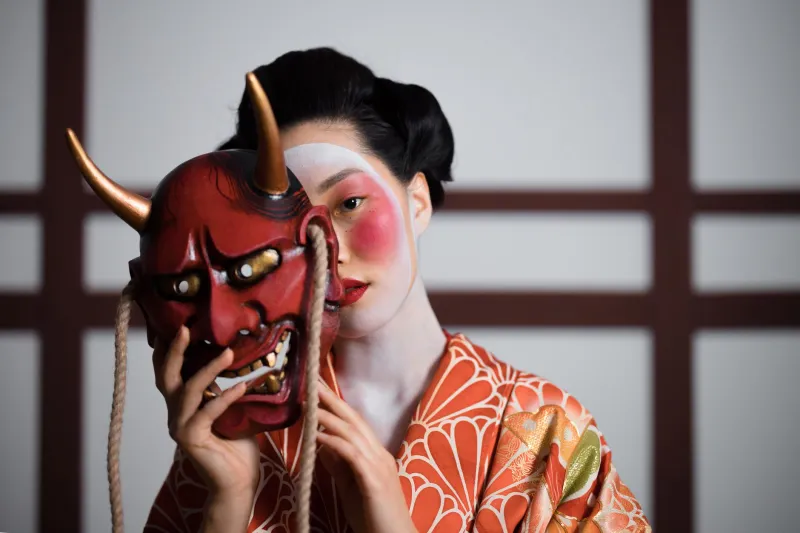
Japanese performance traditions approach the relationship between interior and exterior differently. In Noh theater, one of the foundational influences on Japanese performance culture, the actor's task is not to feel the emotion and express it, but to embody a form so precisely that the emotion arises in the audience through their perception of the form. The distinction is subtle but profound. It places the body not as a vessel for feeling but as the primary instrument of communication—something to be controlled, shaped, and deployed with the same intentionality a musician brings to a phrase.
This inheritance shapes Japanese screen acting in ways that may be invisible to viewers unfamiliar with the tradition, but that reveal themselves clearly once the eye has been trained to look.
Reading the Performance: Specific Cases
Consider the work of Chishū Ryū in Yasujirō Ozu's films. Ryū was Ozu's most trusted collaborator across decades of filmmaking, and his performances are studies in the expressive potential of restraint. In Tokyo Story (1953), he plays an aging father visiting children who have grown too busy for him—a premise of almost unbearable emotional weight. Ryū does not perform that weight. He carries it, silently, in the economy of his movements: the way he sits slightly apart from conversations he is no longer truly part of, the deliberate care with which he handles objects that belong to people who no longer need him. The grief is never announced. It accumulates, gesture by gesture, until it becomes overwhelming.
This is a fundamentally different technique from what American audiences typically encounter. An actor working within the Hollywood emotional tradition might externalize that grief in ways that are legible from across the theater—a trembling voice, a barely suppressed sob. Ryū's performance asks more of the viewer. It requires active reading rather than passive reception. And in that demand, it creates a different quality of intimacy.
Posture as Character Architecture
Beyond individual gestures, Japanese cinema uses posture itself as a primary tool of characterization. The way a character inhabits their physical space—the degree to which they contract or expand, the relationship between their body and the bodies of those around them—communicates social position, psychological state, and narrative trajectory with extraordinary efficiency.
In Masaki Kobayashi's Harakiri (1962), the protagonist's physical bearing shifts across the film in ways that track his interior journey without a single line of dialogue being required. Early scenes establish him as a man who has learned to make himself small—to occupy as little space as possible, to signal deference through every physical choice. As the film progresses and his true history is revealed, his posture changes. He begins to fill the frame differently. The camera does not need to tell us that something fundamental has shifted in his sense of self; his body already has.
This use of posture as character architecture is particularly striking for American viewers accustomed to films that rely on verbal exposition to establish psychological change. The efficiency of physical storytelling, when executed at this level, makes dialogue feel almost redundant.
The Cultural Dimension
It would be a mistake to analyze Japanese physical performance purely in formal terms without acknowledging its cultural substrate. Japan's social codes around the expression of emotion in public—the value placed on enryo (restraint and consideration for others), the complex grammar of bowing and bodily positioning that encodes social hierarchy—mean that physicality carries communicative weight in everyday life that it does not carry in the same way in American culture.
Japanese actors are, in a sense, drawing on a vocabulary that their audiences already read fluently. The precise angle of a bow is not neutral. The decision to maintain or break eye contact is not incidental. These are legible signals within a shared cultural code. For American viewers, learning to read that code—even imperfectly—transforms the experience of watching these films.
What This Asks of the Viewer
Perhaps the most significant implication of Japanese cinema's physical storytelling tradition is what it demands from its audience. These films require a different quality of attention—slower, more patient, more attuned to the visual rather than the verbal. For American viewers shaped by a cinematic culture that tends toward explicitness, this can initially feel like deprivation. The film seems to be withholding something.
But what it is actually doing is offering something different: the opportunity to participate actively in the construction of meaning. When a character's emotional state must be inferred from the tension in their hands rather than extracted from their monologue, the viewer becomes a collaborator rather than a recipient. The understanding that results feels earned in a way that spoken revelation rarely does.
This is the deeper gift of Japanese physical performance—not simply an alternative technique, but an invitation to a more engaged, more demanding, and ultimately more rewarding relationship with the art of cinema.