Written Into the Walls: How Japanese Cinema Makes Class Visible Without Saying a Word
In American cinema, class tends to arrive as dialogue. A character explains where they grew up, what they could not afford, what they had to fight to escape. The socioeconomic condition is narrated — given words, made explicit, placed into the story as information to be processed. The audience understands the character's position because they have been told it.
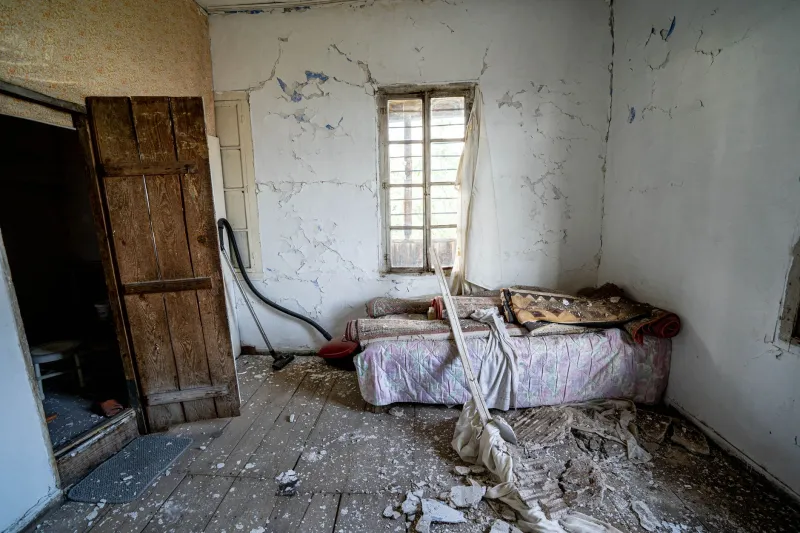
Japanese cinema often takes the opposite approach. Class is not announced. It is deposited — into the peeling plaster of a rented room, the fluorescent flicker above a convenience store break table, the way a body moves through a space that was not designed for it. To watch Japanese film attentively is to learn a different kind of literacy: one that reads social position not through confession but through material evidence.
The Room as Social Document
The interior space in Japanese cinema is rarely neutral. Directors and production designers working within this tradition understand that a room encodes its occupant's position in the social order with a precision that no line of dialogue can match. The question is not whether the room is pleasant or unpleasant. The question is what the room permits — how much it contracts around the person living in it, how many of their movements it forecloses.
Hirokazu Kore-eda has made this spatial compression central to his practice. In Shoplifters (2018), the Shibata family's dwelling is a masterwork of deliberate accumulation — objects stacked against objects, sleeping bodies arranged in configurations that speak of necessity rather than choice. The house is not presented as squalid. It is presented as full, in the way that poverty is always full: full of workarounds, of repurposed things, of the evidence of people making do. The camera does not editorialize. It simply shows the density, and trusts the viewer to feel its weight.
Contrast this with the spare, clean geometries of the wealthy family's home in the same film. Space, in that context, becomes its own form of abundance — room to move, room to be alone, room that does not demand anything of the body occupying it. Kore-eda does not need to explain the difference. He builds it.
Fabric and the Body That Wears It
Clothing in Japanese cinema functions with similar precision. The cut of a garment, its condition, the way it fits or fails to fit a particular body — these are not incidental details. They are arguments.
In Yasujiro Ozu's postwar films, the distinction between those who can afford presentable Western clothing and those who cannot registers as a kind of social archaeology. The worn collar, the suit that has been pressed one too many times, the dress that was fashionable several seasons ago — each communicates a position in the hierarchy without requiring the character to acknowledge it. The characters themselves rarely speak of what they wear. The camera, in its quiet attention, does the speaking for them.
This technique carries forward into contemporary work. In Ryusuke Hamaguchi's films, clothing often marks the subtle gradations within the middle class — the difference between those who are comfortable and those who are performing comfort, between those whose ease is genuine and those for whom ease is an aspiration that their wardrobe has not quite caught up with.
Geography as Stratification
Beyond the interior, Japanese cinema uses urban and suburban geography to map social hierarchy with considerable sophistication. The distance from the city center, the quality of the commute, the character of the neighborhood through which characters travel — all of these function as indicators of position.
Sion Sono's work is particularly attentive to this spatial politics. In Love Exposure (2008) and elsewhere, the margins of Tokyo — the dense residential blocks, the underpasses, the commercial strips that serve populations with limited alternatives — are filmed not as exotic or pitiable but as fully inhabited worlds with their own internal logic. The geography does not explain the characters' circumstances. It contextualizes them, situating individual lives within a spatial order that reflects and reinforces economic stratification.
This approach resists the temptation, common in American cinema, to use impoverished environments as mere backdrop for individual uplift narratives. The space is not waiting to be escaped. It is the condition within which life is actually lived.
The Camera as Class Instrument
Perhaps the most sophisticated dimension of this practice is the degree to which cinematographic choices themselves — lens selection, camera placement, the relationship between frame and subject — encode social meaning.
In films that move between economic registers, the change in visual grammar can be as instructive as any narrative development. Scenes set in working-class environments are frequently shot with a camera that maintains a respectful but unmediated proximity — close enough to register texture and imperfection, distant enough to avoid the voyeuristic compression that can make poverty feel like spectacle. Scenes in affluent spaces sometimes shift register: wider lenses, more controlled lighting, a visual cleanliness that mirrors the social insulation of the environment.
These are not always conscious choices in the sense of being calculated effects. They emerge from a deep attunement to the way that social environments actually look and feel — an attunement that Japanese cinema has cultivated with particular rigor.
What American Viewers Are Learning to See
For audiences trained by a cinema that tends to make class explicit through dialogue and plot, the subtlety of this visual language can initially register as understatement. The social analysis is present and often severe, but it does not announce itself.
This is, in a sense, the point. Japanese directors who work in this mode are not merely describing class difference. They are enacting the way class actually operates — not through declaration but through the accumulated weight of material conditions that shape what is possible, what is visible, and what goes without saying.
To learn to read these films is to develop a new sensitivity to the social information embedded in any image — to understand that the texture of a wall or the geography of a commute is never merely descriptive. It is always, at some level, an argument about who we allow to live where, and at what cost.