Walls That Demand Something: How Japanese Cinema Encodes Moral Duty Into the Spaces Characters Inhabit
American cinema has a long tradition of using space as metaphor. The open road signals freedom; the claustrophobic apartment signals entrapment; the grand estate signals either aspiration or corruption depending on the genre. These are reliable conventions, and they work precisely because they are broadly legible. Japanese cinema operates within a different spatial logic—one less concerned with what space symbolizes than with what space demands.
This distinction is worth dwelling on. In the Japanese filmmaking tradition, physical environments do not merely reflect a character's situation. They actively participate in shaping the moral choices available to that character. The room does not illustrate the dilemma. The room is the dilemma.
The Kitchen as Ethical Enclosure
No space in Japanese domestic cinema is more charged with moral obligation than the kitchen. This is not a coincidence of set design. The kitchen in the Japanese home—particularly as rendered in mid-century films and in the contemporary domestic dramas that inherit their visual grammar—is a space of relentless productivity, poor visibility, and structural isolation from the rest of the household. It is where labor is performed without acknowledgment, where sacrifice is made material in the form of meals that others consume.
When a director frames a character within a kitchen, the geometry of the shot frequently reinforces the ethical condition of the person occupying it. Low angles that emphasize the ceiling pressing down. Frames that cut the character off from the room where the family gathers. The refrigerator, the sink, the cutting board arranged as a series of stations that the character moves between with the efficiency of someone who has long since stopped questioning the circuit.
In Ozu's domestic films, the kitchen is often the site from which female characters observe the family without being fully integrated into it—visible to the audience, invisible to the household. The spatial arrangement is the characterization. No monologue about duty is required when the architecture has already made the argument.
Small Rooms and the Geometry of Constraint
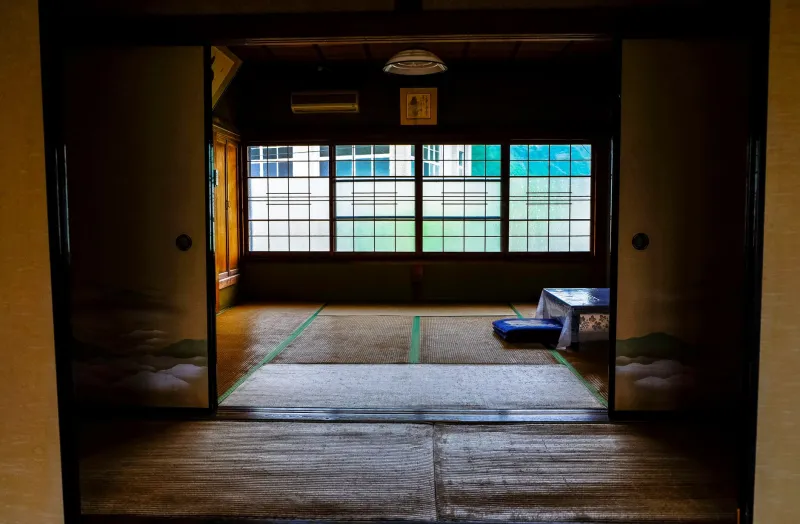
Beyond the kitchen, Japanese cinema repeatedly returns to the small room as a site where moral obligation becomes physically legible. The tatami room that is too modest to suggest poverty but too confined to suggest comfort. The bedroom shared by multiple generations. The study or workspace that has been colonized by a single family member's claim to productive, public labor while others circulate around it.
What these spaces share is a geometry that makes privacy—and therefore genuine individual choice—structurally difficult. American narrative conventions tend to grant protagonists a room of their own, metaphorically if not literally: a space within which they deliberate, arrive at decisions, and emerge transformed. Japanese cinema is far more likely to situate its characters in spaces where deliberation is impossible because solitude is impossible. The moral weight of obligation is not something these characters carry into a room. It is built into the room's dimensions.
This is visible in the work of directors as stylistically different as Mikio Naruse and Kore-eda. In both, the spatial arrangements of domestic life function as a kind of ambient pressure on characters who might, in a different architecture, have made different choices. The question the films implicitly pose is not simply what will this person do? but what can this person do, given the room they are standing in?
Workplaces and the Surrender of the Self
The logic extends beyond the domestic sphere. Japanese cinema's treatment of workplaces—particularly the small, unglamorous ones that appear in films about service workers, craftspeople, and low-level office employees—employs spatial framing to communicate the degree to which professional obligation has colonized a character's sense of identity.
In these environments, directors often use framing that places the worker in precise geometric relationship to the tools, counters, or desks of their trade. The body is positioned not as the center of the frame but as an extension of the workspace itself—one component among several in a system that has its own logic and its own demands. The effect is to render visible what the character may never articulate: that the self has been, through long habit and economic necessity, absorbed into the function.
This is not presented as tragedy in the melodramatic sense. Japanese cinema tends to observe this absorption with the same neutrality it brings to everything else. But the spatial argument is unmistakable: the room has made a claim on the person, and the person has, over time, honored that claim.
Rural Homes and the Weight of Inheritance
Perhaps the most explicitly moral spatial vocabulary in Japanese cinema belongs to the rural home—the ancestral house that appears in films dealing with inheritance, obligation to parents, and the tension between individual aspiration and familial duty. These structures are almost always rendered as physically demanding: dark interiors, low beams, aging materials that require constant maintenance, layouts that are organized around the needs of the household's communal life rather than any individual's comfort.
For the characters who return to these houses—the adult children summoned by illness or death or simple need—the architecture functions as a kind of argument they cannot refute. The house has a claim on them that predates their own preferences. Its age, its disrepair, its particular darkness is not atmospheric dressing. It is the moral case made tangible.
For American audiences accustomed to thinking of setting as backdrop, this spatial grammar requires a deliberate reorientation. The frame is not showing you where the character is. It is showing you what the character owes. Once that shift has been made, the physical world of Japanese cinema becomes as eloquent as any of its performances—and considerably more honest about the weight that spaces, like relationships, accumulate over time.