Holding the Moment: The Fragile Temporality of Japanese Cinematic Time

Photo by Photo by Ryuta on Unsplash on Unsplash
There is a word in Japanese—mono no aware—that has no precise English equivalent, though it is often translated as something like "the pathos of things" or "the bittersweet awareness of impermanence." It describes the particular emotional register that arises when beauty and transience are perceived simultaneously, when the loveliness of something is inseparable from the knowledge that it will not last. It is, among other things, a theory of time.
It is also, whether or not directors explicitly invoke the concept, a governing principle of a great deal of Japanese cinema. The films that embody it most fully do not merely tell stories that are set in time. They create an experience of time itself—a specific quality of presence in which the viewer is made aware, moment to moment, that what is being seen is already passing. The present tense is always edging toward the past. The scene being watched is already becoming a memory.
This is a radically different relationship to narrative time than the one American cinema has cultivated, and understanding the difference is essential to understanding why Japanese films feel the way they do.
Momentum Versus Presence
Mainstream American cinema is, at its core, a cinema of momentum. Scenes exist in relation to what they are building toward. Every shot is implicitly justified by what it sets up, every pause by the tension it creates before release. The viewer's attention is oriented forward—toward the next development, the next revelation, the resolution that the entire structure is designed to deliver. Time, in this model, is a resource. It is spent in pursuit of something.
Japanese cinema, in its most characteristic register, treats time not as a resource but as a substance. It has texture, weight, and quality. A scene does not primarily exist to advance a plot; it exists to be inhabited. The camera lingers not because it is withholding information but because it is insisting on the full presence of what is there. The pause is not a prelude to action. It is itself the point.
This distinction becomes visible in the most practical of ways: in the length of shots, in the silence between lines of dialogue, in the willingness to remain in a space after the apparent dramatic action has concluded. Directors like Ozu, Naomi Kawase, and Ryusuke Hamaguchi have all, in different ways, built their filmmaking practice around this insistence on presence—on the idea that a moment fully seen is worth more than a story efficiently told.
The Shot That Stays Too Long
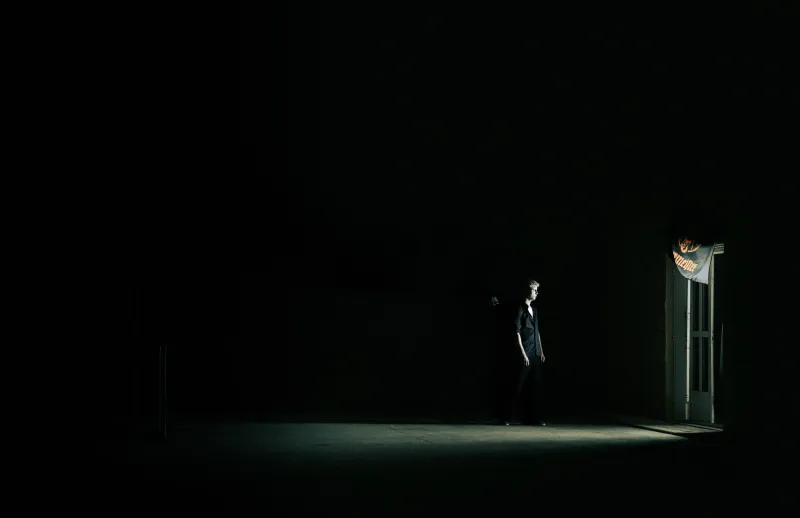
One of the most reliable markers of this temporal philosophy is what might be called the overstaying shot—a shot that continues beyond the point at which a Western editor would cut. The scene has, by conventional standards, concluded. The information has been delivered. And yet the camera remains, watching the space that the characters have just left, or watching a character who is no longer speaking, or watching the window through which the light is slowly changing.
For viewers trained on American pacing, this can initially register as an error—as if the director failed to call cut in time, or the editor forgot to trim the excess. But there is no excess here. The duration is the content. What is being communicated is precisely the experience of time continuing after the human drama within it has paused—the world persisting, indifferent to the story it is hosting.
Ozu's famous pillow shots—the brief, contemplative images of objects, landscapes, or empty spaces that punctuate his narratives—are perhaps the most celebrated version of this technique. They do not advance the plot. They do not provide visual information that could not be conveyed in a quarter of the time. What they do is create a rhythm of attention in which the viewer is periodically asked to stop moving forward and simply be present with what is there. They are, in effect, instructions in a different way of watching.
The Scene as Farewell
The temporal sensibility of Japanese cinema has a specific emotional consequence that becomes apparent over the course of a film: every scene begins to feel valedictory. Because the viewer has been trained, through the pacing and the quality of attention the film demands, to be present with what is happening rather than anticipating what comes next, there is a growing awareness that what is being seen will not be seen again in quite this way.
This is most evident in films that deal explicitly with memory, loss, or the passage of time—Kore-eda's Still Walking (2008), for instance, or Kawase's An (2015)—but it is present even in films whose subject matter does not obviously invite it. The quality of attention that these directors cultivate creates a kind of preemptive nostalgia, a tenderness toward the present moment that arises from the awareness of its fragility.
American cinema occasionally achieves something similar, but it tends to do so through narrative means—by making the viewer aware that a character is about to die, or that a relationship is about to end, so that the scenes preceding the loss take on a retrospective weight. Japanese cinema achieves the same emotional quality through purely cinematic means, without requiring the narrative scaffolding. The pacing itself generates the feeling.
What This Asks of the American Viewer
The demand this places on viewers accustomed to forward momentum is real and should not be understated. To watch a Japanese film in this mode is to practice a form of attention that runs counter to the habits most American moviegoers have spent years developing. It requires a willingness to release the question "what happens next" and replace it with something closer to "what is here, right now."
This is not a passive state. It is, in fact, more actively demanding than the forward-oriented attention that narrative momentum requires, because it asks the viewer to generate meaning from duration and presence rather than from event and consequence. The reward, for those willing to make the adjustment, is an experience of cinema that feels less like consuming a story and more like sharing a span of time with people who, for the duration of the film, become genuinely present.
The Memory the Film Becomes
There is a final dimension to this temporal philosophy that is worth naming. Films that treat each scene as already in the process of becoming memory tend to be remembered differently than films that do not. They leave residues rather than plots. What persists after the viewing is not the sequence of events but the texture of specific moments—the quality of light in a particular shot, the length of a particular silence, the feeling of having been present in a room with people who were, for a brief time, completely real.
This is what Japanese cinema, at its most characteristic, is reaching for: not the delivery of a story but the creation of an experience that, like all genuine experience, leaves its mark in the body and the memory long after the screen has gone dark. Each scene treated as if it might disappear. Each moment held, for as long as the camera allows, before it passes into the past.